


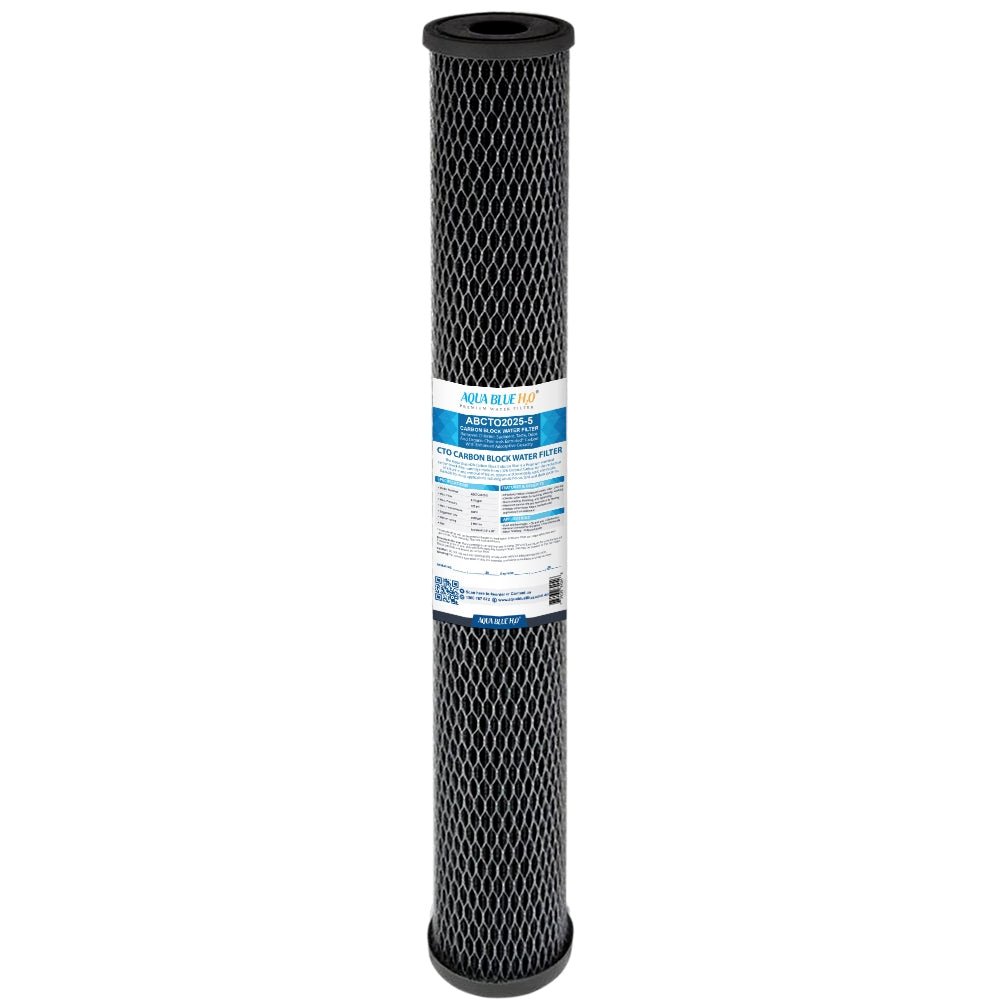
- Carbon is used for organics and chlorine removal,improving taste and smell.
- Min temperatures 5 deg. C.
- Max temperatures 60 deg. C.
- Max operating differential pressure 1 bar.
- Cartridge lengths: 20".
Activated Carbon Filters
Activated carbon filters are particularly effective at removing pollutants which create unpleasant taste, colour, and odour in water. These fast-acting filters can eliminate or reduce the levels of chlorine by-products, pesticides, herbicides, and other organic and industrial chemicals.
Carbon block filters are made of finely powdered carbon compressed into a solid mass and the activated carbon is made from a variety of organic materials such as coal,coconut, lignite, and wood.
Of all carbon forms solid carbon block (CB) filters are the most efficient and cost effective method of removing volatile organic carbon compounds (VOC's, insecticides, pesticides and industrial solvents) from drinking water.
The block of carbon mechanically strains out dirt, sediment, rust, algae, bacteria, microscopic worms, cryptosporidium and asbestos. This is all accomplished by water pressure. The compacted solid carbon block filter is designed to mechanically filter particles down to sub micron size. By micro straining the water, the consumer is assured that only the cleanest, clearest water is delivered to the point of use.
Activated carbon bonds to thousands of chemicals. In fact, carbon will bond to most chemicals known! When water is forced through the solid carbon block, it is forced to slow down and increase the contact time with the carbon, allowing the carbon bonding to take place to remove chemical pollutants like toxins, pesticides, THM's, chlorine, bad tastes, odors, etc. Heavy metals like lead do not bond to the carbon, but are strained out by the pore size of the block. Basically, it's like trying to put a basketball through a hole the size of a golf ball.
There are two forms of carbon in general use: granular and block. Carbon granules are about the size of coarse sand while carbon block is finely powdered carbon compressed into a solid mass.
To get the most of a carbon filter, it should be kept free of sediment and heavy organic impurities by the incorporation of a sediment filter as an integral part of the system design. It is imperative that filter cartridges be replaced regularly before they reach their expiry date, rather than after.
Why Coconut shell activated carbon is the most preferred choice in the industry:-
Activated carbon from coconut shell has predominantly pores in micro pore range. Almost 85-90% surface area of coconut shell activated carbon exists as micro-pores. These small pores match the size of contaminant molecules in drinking water and therefore are very effective in trapping them.
Peat and wood activated carbon has mostly meso and macro-pores which suit trapping of bigger molecules. The pore structure of coal carbons falls between coconut shell and wood based carbons.
Macro-pores are considered as an access point to micro-pores. Meso-pores do not usually play an important role in the adsorption unless the surface area of these pores is large, 400 m2/g or more.
The predominance of micro-pores in coconut shell carbon gives it tight structure and provides good mechanical strength and hardness and also high resistance to resist attrition or wearing away by friction.
Some of other features which carbon industries see as a great advantage in favour of coconut carbon are as follows:
- Coconut is a renewable source of carbon
- Coconuts grow throughout the year, with harvesting generally occurring 3-4 times in a year
- Coconut tree can be preserved for many years
On the whole, activated carbon plays a very critical role in drinking water purification as described.
To summarize, the key points are as follows:
- Absorbs disinfection by-products like THM's
- Absorbs VOCs (Volatile Organic Compounds)
- Absorbs pesticides and herbicides
- Removes halogens from water
- Improves appearance of drinking water
- Improves taste of drinking water
Compatible Models
Please refer to the product description above for compatible filter numbers, refrigerator models and system model information.
Need Help Confirming Compatibility?
If you cannot find your model number or are unsure whether this product is suitable for your refrigerator or filtration system, please contact us before purchasing.
Contact Us for Compatibility SupportGeneral Installation Guide
Please use the general guide below to help identify your filter type and follow the correct replacement process. Filter location and replacement steps may vary depending on your refrigerator or water filtration system model. Always refer to your appliance manual for the exact filter location and specific instructions.

Need Help Finding the Correct Filter?
Before ordering, compare your old filter, check the model number or filter code and confirm the connector type. If you are unsure, please contact Water Filter Distributors for assistance.

Whole House System Installation Manual
For whole house filtration systems, please refer to the detailed installation manual below. Professional installation by a licensed plumber is recommended.
View Whole House Installation ManualTwin Cartridge Under Sink Installation Guide
For twin cartridge under sink systems, please refer to the installation guide below. This guide is suitable for systems supplied with a dedicated faucet, diverter valve, tubing and installation kit.

Important Installation Notes
- Filter location and replacement steps may vary depending on your appliance or filtration system model.
- Always compare the new filter with your existing filter before installation.
- Remove all protective caps, plugs and packaging before installation.
- Flush approximately 5–10 litres or 3–5 minutes of water after installing the new filter.
- Use with cold potable water only unless the product instructions specifically state otherwise.
- Check all connections carefully for leaks after installation.
- Always follow your appliance manufacturer's instructions where applicable.
Need Installation Assistance?
If you are unsure how to install this product, please send us your refrigerator model number, filtration system model number or a clear photo of your existing filter and connections.
Contact Us for Installation SupportCertification & Quality Assurance
Water Filter Distributors is operated by Mexi Trading Pty Ltd, an Australian owned and operated company. Our products are supplied with a strong focus on quality, safety and trusted filtration performance.


Important Certification Notice
- Certification details may vary depending on the specific product model.
- Please refer to the product description, packaging or official documentation for model-specific certification information.
- If you require confirmation for a specific product, please contact Water Filter Distributors before purchasing.